Greetings in the love and grace of our Lord Jesus Christ.
I want to take a moment to thank each of you for your continued love, prayers, encouragement, and faithful support. Your kindness means more than words can express, and I thank God for every person who walks alongside this ministry journey.
By God’s grace, I am doing well and staying busy as I continue caring for the life and calling He has entrusted to me. In this season, I am pursuing my MBA in Business Administration at Atlanta College of Liberal Arts and Sciences. My desire is not simply to earn a degree, but to grow in wisdom, leadership, and practical knowledge so that I may become an expert in Business Administration and use those skills to serve and bless our increasingly complex world.
As an ordained chaplain, I remain committed to serving others through devotionals, personal correspondence, community ministry, and words of encouragement that reach people across the globe. My heart is to create spaces where people can pause, reflect, rest, and rediscover God’s nearness in their lives. Whether through a devotional thought, a note of encouragement, a prayer, or a reflection for life’s various seasons, my goal is always to point hearts toward the faithfulness and love of Christ.
My ministry continues to be guided by compassion, clarity, and complete trust in God’s unfailing love. I believe that even in difficult times, the Lord remains present, working quietly and powerfully in our lives. It is a privilege to walk alongside others as they seek comfort, guidance, hope, and spiritual renewal.
Please know that I deeply appreciate your comments, messages, and prayer requests. While I am not always able to respond personally to every communication due to the demands of ministry, education, and daily responsibilities, I do read them and keep them in prayer whenever possible.
May the Lord bless you, strengthen you, and surround you with His peace. Thank you for being part of this ministry and for your continued friendship, encouragement, and support. Your prayers and kindness help make this work possible, and I am truly grateful.
With love, prayers, and gratitude,
Chaplain Edwin Everly
MBA Candidate, Business Administration
Atlanta College of Liberal Arts and Sciences
“May the Lord direct your hearts into God’s love and Christ’s perseverance.” (2 Thessalonians 3:5)
Key Scripture: “Where there is no vision, the people perish: but he that keepeth the law, happy is he.” (Proverbs 29:18 KJV)
Introduction
God did not create us to wander aimlessly through life. He created each person with purpose, destiny, and divine assignments. Throughout Scripture, we find men and women who accomplished great things because they knew their purpose, trusted God’s plan, and persevered despite obstacles.
Success from a biblical perspective is not merely the accumulation of wealth, possessions, or status. True success is faithfully fulfilling God’s purpose for our lives while developing Christlike character along the journey.
Let us examine the biblical principles that form the foundation of lasting achievement and effective Christian living.
1. Purpose: The Foundation of Achievement
Every significant accomplishment begins with a clear purpose.
Before Noah built the ark, God gave him a clear assignment. Before Nehemiah rebuilt Jerusalem’s walls, he carried a burden and vision in his heart. Before Paul journeyed throughout the known world preaching the Gospel, he received a divine calling.
Without purpose, people drift.
“For I know the plans I have for you, saith the Lord, plans for good and not for evil, to give you an expected end.” (Jeremiah 29:11)
An “expected end” implies a destination. God works with goals and purposes. If we do not know where we are going, we will have difficulty recognizing whether we are making progress.
Application
Ask yourself:
What has God called me to do?
What burden has He placed on my heart?
What am I building for His glory?
Purpose gives direction to every other decision.
2. Defending Your Purpose
Once purpose is established, it must be protected.
Nehemiah faced opposition when rebuilding Jerusalem’s walls. His enemies attempted distractions, criticism, intimidation, and compromise.
Nehemiah responded:
“I am doing a great work, so that I cannot come down.” (Nehemiah 6:3)
Purpose must be defended against:
Distractions
Discouragement
Fear
Negative influences
Time-wasting activities
Not every opportunity is from God. Not every invitation deserves a “yes.”
When God gives an assignment, we must learn to guard it carefully.
3. Goal Setting: Turning Vision Into Action
Vision provides direction, but goals provide steps.
Jesus Himself demonstrated intentionality.
“I must work the works of him that sent me, while it is day.” (John 9:4)
Everything Christ did was purposeful.
Many people wish for success, but wishes without plans produce frustration.
Habakkuk was instructed:
“Write the vision, and make it plain upon tables, that he may run that readeth it.” (Habakkuk 2:2)
A written goal transforms a dream into a destination.
Practical Principle
Vision answers “Why?”
Goals answer “What?”
Plans answer “How?”
Without these, life tends to drift with circumstances rather than advance toward purpose.
4. Self-Discipline: Doing What Is Needed
God honors discipline.
The Apostle Paul compared the Christian life to an athlete preparing for competition.
“But I keep under my body, and bring it into subjection.” (1 Corinthians 9:27)
Self-discipline means doing what is right even when feelings say otherwise.
Many people wait until they feel motivated.
Biblical maturity teaches the opposite.
Pray when you do not feel like praying.
Study when you do not feel like studying.
Serve when you do not feel like serving.
Continue working when enthusiasm fades.
Character is revealed when obedience continues beyond emotion.
5. Consistency: Small Daily Actions Produce Great Results
The greatest achievements usually do not happen suddenly.
They develop through faithful daily effort.
Jesus taught:
“He that is faithful in that which is least is faithful also in much.” (Luke 16:10)
The Kingdom principle is consistency.
A little prayer every day.
A little study every day.
A little kindness every day.
A little progress every day.
These seemingly small actions accumulate into significant results over time.
The giant oak tree began as a tiny acorn.
Likewise, great ministries, businesses, families, and accomplishments are often built one faithful day at a time.
6. Present Your Best Self
As believers, we represent Christ.
“And whatsoever ye do, do it heartily, as to the Lord, and not unto men.” (Colossians 3:23)
God deserves our best effort.
This does not mean perfection.
It means excellence.
Whether serving in ministry, performing a job, managing finances, or interacting with others, we should strive to reflect integrity, diligence, and honor.
People should see Christ’s character in our work ethic and attitude.
7. Repetition Produces Mastery
God often teaches through repetition.
Israel learned through repeated instruction.
The disciples learned through repeated teaching.
Spiritual growth itself is a process of continual practice.
“Exercise thyself rather unto godliness.” (1 Timothy 4:7)
Excellence rarely arrives instantly.
Skills grow through repetition.
Knowledge grows through repetition.
Character grows through repetition.
What we repeatedly do becomes what we eventually become.
Success is often the result of doing ordinary things extraordinarily well for a long time.
8. Attitude: Viewing Setbacks Through God’s Perspective
Every believer experiences disappointments.
Joseph was sold into slavery.
David fled from Saul.
Paul endured imprisonment.
Yet God used each setback for a greater purpose.
“And we know that all things work together for good to them that love God.” (Romans 8:28)
What appears to be failure may actually be divine redirection.
Sometimes God closes one door to lead us toward a better one.
A godly attitude recognizes:
Setbacks are temporary.
Lessons are valuable.
God’s plan is still unfolding.
Every trial can become preparation.
What the world calls failure, God often uses as training.
9. Patience: Trusting God’s Timing
Modern culture demands immediate results.
God often works differently.
“But let patience have her perfect work.” (James 1:4)
Many biblical promises required years of waiting.
Abraham waited for Isaac.
Joseph waited for promotion.
David waited for the throne.
God develops character through the waiting process.
Great things take time.
Growth takes time.
Wisdom takes time.
Spiritual maturity takes time.
Patience is not passive. It is trusting God while continuing faithfully in obedience.
10. Perseverance: Never Give Up
The difference between success and failure is often persistence.
“Let us not be weary in well doing: for in due season we shall reap, if we faint not.” (Galatians 6:9)
Every worthwhile pursuit will encounter obstacles.
There will be:
Delays
Criticism
Setbacks
Disappointments
Unexpected challenges
Perseverance means refusing to quit.
The enemy often attacks just before breakthrough.
God’s people must develop a holy determination that says:
“I will continue trusting God. I will continue walking by faith. I will continue moving forward.”
11. Action: Begin Now
Many people spend their lives waiting for the perfect time.
Scripture consistently calls us to action.
“Be ye doers of the word, and not hearers only.” (James 1:22)
Progress begins when action begins.
Speed is not the determining factor.
Direction is.
A person moving slowly toward God’s purpose will accomplish more than a person standing still while waiting for ideal circumstances.
The best time to obey God is now.
The best time to begin is now.
The best time to move forward in faith is now.
Conclusion
God’s pattern for achievement is clear:
Discover your purpose.
Defend that purpose.
Establish clear goals.
Practice self-discipline.
Remain consistent.
Give your best effort.
Master skills through repetition.
Maintain a godly attitude.
Exercise patience.
Persevere through difficulties.
Take action immediately.
As believers, our ultimate goal is not simply success in the eyes of the world, but faithfulness before God.
“Well done, thou good and faithful servant.” (Matthew 25:21)
May we live with purpose, walk with discipline, persevere through every challenge, and faithfully pursue the calling God has placed upon our lives until the work He has entrusted to us is complete. Amen 💕✌️🙏
A traveler follows a scripture-marked path toward a sunlit hilltop city, guided by faith and biblical principles.
Scripture Reading: John 17:20-23; Galatians 2:20; Romans 12:1-2
Throughout history, people have sought to understand who they are, why they exist, and how they may experience a deeper sense of spiritual fulfillment. Within yogic philosophy, yoga is often described as “union,” the joining of the individual self with ultimate reality. This concept invites practitioners to become more aware of their thoughts, habits, dietary choices, and spiritual development as they pursue greater harmony and understanding.
While Scripture presents a different theological framework, it also speaks to humanity’s deep longing for connection and wholeness. The Bible teaches that our ultimate fulfillment is found not in discovering our union with an impersonal reality, but in a living relationship with the personal God who created us and revealed Himself through Jesus Christ.
In John 17, Jesus prayed for His followers, saying, “that they all may be one, as You, Father, are in Me, and I in You.” This divine invitation is not merely intellectual or religious. It is relational. Through faith, believers are united with Christ and brought into fellowship with God by grace.
Just as yogic discipline encourages self-examination, Scripture calls believers to examine their hearts. The Apostle Paul writes in Romans 12:2, “Be transformed by the renewing of your mind.” Spiritual growth involves becoming aware of our thoughts, attitudes, and behaviors so that they may be aligned with God’s truth. We are invited to reflect honestly upon the beliefs we entertain, the habits we cultivate, and the influences that shape our lives.
Our daily choices also matter. The foods we consume, the activities we pursue, and the rhythms we establish can affect our physical, emotional, and spiritual well-being. While Christianity does not typically define spirituality through dietary practices, it does teach stewardship of the body as a gift from God. Caring for ourselves wisely can support a life of service, worship, and devotion.
The pursuit of spiritual progress is another area where meaningful reflection may occur. In yogic traditions, progress is often associated with increased awareness and harmony. In the Christian life, growth is recognized through the fruit of the Spirit: love, joy, peace, patience, kindness, goodness, faithfulness, gentleness, and self-control. These qualities are not achieved through self-effort alone but are produced through the gracious work of the Holy Spirit within us.
Perhaps the deepest lesson is that true transformation begins with grace. We do not strive to earn God’s acceptance. Rather, because we are already loved and accepted in Christ, we are free to grow, learn, and mature spiritually. Our practices of prayer, meditation upon Scripture, self-examination, and healthy living become responses to God’s love rather than attempts to obtain it.
Reflection Questions
What thoughts or habits most influence your spiritual life today?
In what ways are you experiencing the renewing work of God’s grace?
How do your daily choices reflect your desire to honor God?
What evidence of spiritual growth can you identify in your life?
How might a deeper awareness of God’s presence reshape your relationship with yourself and others?
Closing Prayer
Dear Gracious Father, thank You for creating us with a desire to know You and walk in Your ways. Help us to examine our hearts with honesty and humility. Renew our minds, guide our daily choices, and shape our character through Your Spirit. May we grow in the grace and knowledge of Jesus Christ, discovering ever more deeply the joy of life in communion with You. Amen.
I value your feedback. If you have questions, comments, or suggestions, please share them. I’m a one-man ministry here, and I’ll respond to everyone. May God bless you and your loved ones. 💕✌️🙏
A robed traveler kneels in prayer as golden sunlight breaks through dramatic clouds over the valley.
A study on the eternal, loving Triune God — Father, Son, and Holy Spirit — and the grace, goodness, and unconditional love at the heart of His nature.
Opening Reflection
This week’s lesson begins where our faith begins: with who God is. We believe in the eternal, loving Triune God—Father, Son, and Holy Spirit—who exists in perfect unity, delight, and purpose. God’s nature is pure grace, goodness, and unconditional love. Before we study what God does in Scripture, we anchor ourselves in who God has always been: three Persons, one God, bound together in love from before the world began, and overflowing that love toward us.
Scripture Focus
Genesis 1:26; Matthew 3:16-17; Matthew 28:19; John 1:1-3; John 17:20-24; Romans 5:8; 2 Corinthians 13:14; Ephesians 2:8-9; Colossians 2:9; 1 John 4:8-10
One God in Three Persons: Perfect Unity
Scripture reveals one God who exists eternally as three Persons—Father, Son, and Holy Spirit—perfectly united in essence and will. When Jesus commissioned His disciples, He instructed them to baptize “in the name of the Father, and of the Son, and of the Holy Ghost” (Matthew 28:19), a single name shared by three Persons. In His high priestly prayer, Jesus asked that His followers would be one “as thou, Father, art in me, and I in thee” (John 17:21), pointing to the Trinity itself as the model of perfect unity. Paul closes his second letter to the Corinthians with a blessing that names all three Persons together: “The grace of the Lord Jesus Christ, and the love of God, and the communion of the Holy Ghost, be with you all” (2 Corinthians 13:14). The Trinity is not three gods cooperating, nor one God wearing three masks, but one God in three Persons, undivided in nature and purpose.
Delight and Purpose Within the Godhead
Long before creation existed, the Father, Son, and Spirit delighted in one another. Jesus prayed, “for thou lovedst me before the foundation of the world” (John 17:24), revealing a love between Father and Son that has no beginning. John opens his Gospel by placing the Son—the Word—eternally “with God” and active in creation itself: “All things were made by him; and without him was not any thing made that was made” (John 1:1-3). Creation, then, was not God filling a lack, but the overflow of a joy and purpose already complete within the Godhead. The wonder of the gospel is that this same delight is extended outward, inviting us into the fellowship the Father, Son, and Spirit have always shared.
Grace, Goodness, and Unconditional Love
God’s nature is not divided between justice and love, or holiness and grace—His goodness is the ground of everything else true about Him. Paul writes plainly that our salvation is “by grace…through faith; and that not of yourselves: it is the gift of God: not of works, lest any man should boast” (Ephesians 2:8-9). This grace was not earned or triggered by our worthiness; Paul insists that “God commendeth his love toward us, in that, while we were yet sinners, Christ died for us” (Romans 5:8). John goes further still, describing love not merely as something God does but as who God is: “God is love” (1 John 4:8), a love made visible when “God sent his only begotten Son into the world, that we might live through him” (1 John 4:9). Because God’s love does not depend on our performance, it cannot be earned, and it cannot be lost by those who are His—it is unconditional because it flows from His unchanging nature.
Discussion Questions
How does knowing God exists eternally in loving relationship—Father, Son, and Spirit—change the way you understand your own need for relationship and community?
Where in your life have you struggled to believe God’s love is truly unconditional? What would change if you fully believed Ephesians 2:8-9?
The Trinity’s unity is described as a model for believers (John 17:21). What practical step could your family, small group, or church take this week to reflect that unity?
Romans 5:8 says Christ died for us “while we were yet sinners.” How does this truth reshape how you extend grace to others who haven’tearned it?
Spend a moment simply delighting in who God is, apart from anything He has done for you. What comes to mind?
Closing Prayer
Eternal Father, Son, and Holy Spirit, thank You for being complete in perfect love before we ever existed, and for inviting us into that love freely, by grace alone. Teach us this week to rest in Your unconditional love, to reflect Your unity with one another, and to delight in who You are. In Jesus’ name, Amen 💕✌️🙏
A richly colored religious painting presents the Trinity, crucifixion, and heavenly dove beneath the inscription “The Triune God of Grace.”
“Whatever makes your soul happy, do it.” — A Grace‑Centered Reflection
Takeaway: The joy that rises from your soul is not random or selfish—it is often the quiet voice of the Holy Spirit leading you toward life, peace, and wholeness.
A Grace‑Centered Teaching
The phrase “Whatever makes your soul happy, do it” is not a call to reckless living. It is an invitation to listen to the deepest part of yourself—the place where the Spirit dwells, where Christ abides, and where the Father delights in you.
Scripture teaches that true joy is a fruit of the Spirit. Not the surface happiness that fades, but the deep, steady joy that comes from alignment with God’s heart.
“The joy of the Lord is your strength.” (Nehemiah 8:10)
“In Your presence is fullness of joy.” (Psalm 16:11)
“My peace I give you… not as the world gives.” (John 14:27)
When your soul is happy in God, you are living from your truest identity.
What Makes the Soul Happy?
Each item begins with a Guided Link so you can explore further if you choose.
Rest in God — Joy rises when you stop striving and let grace hold you.
Acts of kindness — Serving others aligns you with the heart of Christ.
Creative expression — Writing, singing, painting, or building awakens the image of God within you.
Quiet reflection — Stillness lets your soul breathe.
Healthy boundaries — Saying “no” to what drains you is saying “yes” to what God desires for you.
Community and connection — Joy grows when you walk with others in grace.
Your soul is happiest when it is free, loved, and rooted in the Triune God.
A Short Devotional Thought
When you choose what makes your soul happy, you are choosing what brings you closer to God’s presence. Joy is not a luxury—it is a spiritual compass. Follow it, and you will find yourself walking in the path God has already prepared for you.
A Prayer for This Week
Dear Holy One, Teach us to listen to the quiet joy within our souls. Let Your Spirit guide us toward what brings life, peace, and wholeness. Free us from fear, obligation, and striving. Let our choices reflect Your goodness and our identity in You. May joy be our strength, peace be our companion, and grace be our way of living. Amen 💕✌️🙏
An artist paints a joyful mountain landscape surrounded by wildflowers and breathtaking alpine scenery.
The gospel is not hard to understand. It is about being friends, showing grace, and knowing God is always with us.
1. The Gospel Begins With Friendship
Jesus loved spending time with people. He didn’t need big buildings or fancy places. He showed God’s love by being with others.
Jesus ate meals with people.
He walked with His friends.
He talked with people who felt lonely.
He welcomed anyone who needed love.
Jesus shows us that the gospel grows when we spend time together, help each other, and share God’s love.
“Where two or three are gathered in my name, I am there with them.” — Matthew 18:20
Children’s point: The gospel is simple—be kind, be together, and share God’s love.
2. The Gospel Is Grace—A Gift From God
Grace means God loves us even when we make mistakes. We don’t earn grace. We don’t work for it. God gives it because God loves us.
Grace:
Forgives us
Helps us try again
Welcomes everyone
Gives us strength when we feel tired or sad
“By grace you have been saved… it is the gift of God.” — Ephesians 2:8
Children’s point: Grace is God’s gift. We receive it, and we share it with others.
3. The Gospel Is God’s Presence—God Is With Us
Jesus came to show us that God is not far away. God is close, loving, and always with us.
When we feel:
Sad — God comforts us
Confused — God guides us
Weak — God strengthens us
Lonely — God stays with us
Afraid — God gives peace
“I am with you always.” — Matthew 28:20
Children’s point: The gospel is simple—God is with us every day.
4. How We Live This Out
When we remember friendship, grace, and God’s presence, we learn to live like Jesus:
We welcome others because God welcomes us
We forgive because God forgives us
We help others because God helps us
We walk with people because God walks with us
We rest in God’s love because God loves us first
Children’s point: The gospel is not heavy or hard. It is a simple life of love, kindness, and trust in God.
5. Prayer
Dear God, Thank You for making the gospel simple enough for everyone to understand. Help us be good friends, show grace to others, and remember that You are always with us. Fill our hearts with Your love and guide our steps each day. Amen 💕✌️🙏
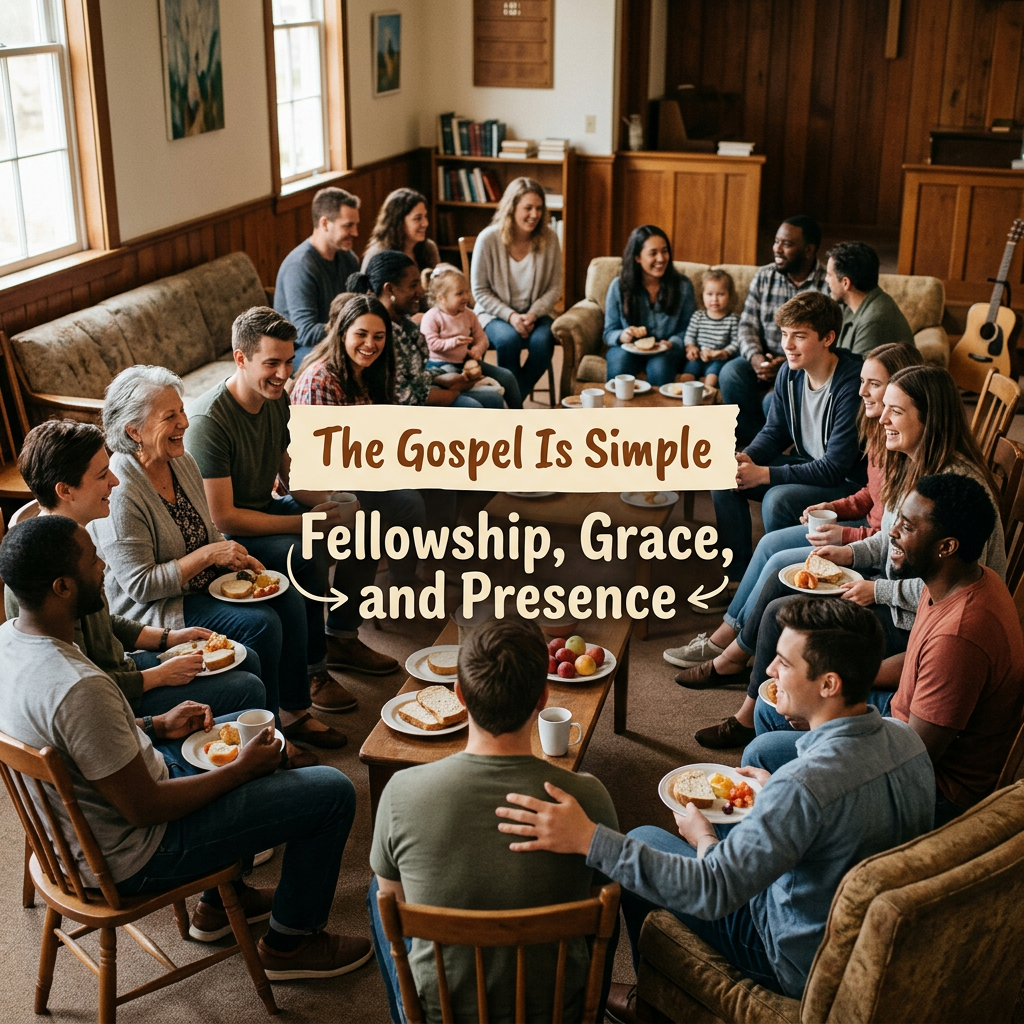
Five friends share laughter and fellowship around a fire beneath a message about grace and God’s presence.
Takeaway: The heart of the gospel is not complexity, ritual, or performance. It is simple fellowship, abundant grace, and God’s faithful presence among ordinary people.
1. The Gospel Begins in Simple Fellowship
From the beginning, God has revealed the gospel through shared life. Jesus did not build His ministry around institutions or grand structures—He built it around tables, meals, conversations, and relationships.
Jesus ate with tax collectors and sinners.
He walked dusty roads with disciples.
He taught in homes, fields, and marketplaces.
He welcomed the lonely, the overlooked, and the broken.
Fellowship is not an accessory to the gospel—it is the environment where the gospel becomes visible.
“Where two or three are gathered in my name, there am I among them.” — Matthew 18:20
The gospel is not complicated. It is people gathered in love, sharing life in Christ.
2. The Gospel Is Grace—Freely Given, Freely Received
Grace is the center of the gospel. Not human achievement, not moral perfection, not religious performance. Grace is God’s unearned kindness poured out on humanity.
Grace forgives.
Grace restores.
Grace lifts the fallen.
Grace welcomes the outsider.
Grace empowers the weary.
Paul reminds us:
“By grace you have been saved through faith… it is the gift of God.” — Ephesians 2:8
Grace is not a ladder we climb—it is a gift we receive. Grace is not a burden—it is freedom. Grace is not a demand—it is love.
The gospel is simple because grace is simple: God gives, and we receive.
3. The Gospel Is Presence—God With Us
The gospel is not merely a message; it is Emmanuel—God with us. Jesus did not come only to teach us about God; He came to be God among us.
His presence changes everything:
In sorrow, He is comfort.
In confusion, He is wisdom.
In weakness, He is strength.
In loneliness, He is companionship.
In fear, He is peace.
The gospel is not a distant promise—it is a present reality. God is not far away; God is here. God is not silent; God speaks. God is not absent; God abides.
“I am with you always, to the end of the age.” — Matthew 28:20
The gospel is simple because God’s presence is simple: God stays.
4. How These Three Truths Shape Our Lives
When we embrace fellowship, grace, and presence, the gospel becomes a lived experience:
We welcome others because God welcomed us.
We forgive because we have been forgiven.
We encourage because God encourages us.
We walk with people because God walks with us.
We rest in God’s love because God rests His love on us.
The gospel is not a heavy burden—it is a gentle invitation. It is not a complicated system—it is a simple life lived with God and one another.
5. A Prayer for Those Learning This Gospel
Dear Holy One, Teach us the simplicity of Your gospel. Let fellowship be our way of living, grace be our way of loving, and Your presence be our way of walking through each day.
Free us from the weight of performance. Draw us into the joy of shared life. Let Your grace shape our hearts, and let Your presence steady our steps.
May our homes, our conversations, and our ministries reflect the simplicity of Your love. Amen💕✌️🙏
A diverse group gathers around music, conversation, coffee, and shared faith in a welcoming living room.
The Bible says God cares when people are hungry, tired, or scared. “The Lord is good to all; He has compassion on all He has made.” — Psalm 145:9
When we help make sure people have food, a safe place to live, and good healthcare, we are doing God’s work.
Helping people find homes
Making sure everyone has enough food
Helping people get medical care
These things help people feel safe and loved.
2. God Wants Communities to Be Safe and Kind
God loves when people treat each other with kindness and fairness. “Love your neighbor as yourself.” — Mark 12:31
Safe neighborhoods, safe schools, and safe workplaces help people feel protected and calm.
Creating safe places
Helping families stay strong
When people feel safe, they can grow, learn, and enjoy life.
3. God Made Us to Be Together, Not Alone
God knows that being lonely hurts. “Encourage one another and build each other up.” — 1 Thessalonians 5:11
Friends, family, and caring adults help people feel connected and valued.
Making friends
Including others who feel left out
When people feel like they belong, their hearts feel lighter.
4. God Gives Us Hope
Hope means believing that good things can happen. “May the God of hope fill you with joy and peace.” — Romans 15:13
Giving people hope — reminding them they matter, that God loves them, and that they are not alone — helps them stay strong during hard times.
Sharing hope
Helping others feel special
Hope is one of the greatest gifts we can give.
Putting It All Together
Suicide prevention means helping people feel safe, loved, supported, and hopeful. Children can help by:
Being kind
Sharing
Including others
Asking adults for help when someone seems sad
Praying for people who are hurting
These small acts show God’s love in big ways.
Let’s Pray: “God, Help Us Care Like You Do”
Dear Holy God,Thank You for caring about every part of our lives.Help us be kind, gentle, and loving to others.Show us how to help people feel safe, supported, and valued.Teach us to share, include others, and give hope.Bless everyone who feels sad or scared today.Let them feel Your love and our kindness. Amen💕✌️🙏
🌿 The Bible consistently presents life as a sacred gift and calls God’s people to protect, uphold, and nurture that life in every way possible. Suicide prevention is not only about mental health treatment — it is about building communities where people can flourish. Scripture shows that when people lack safety, food, shelter, justice, or belonging, despair grows. When people experience care, stability, and hope, life becomes bearable again.
1. God cares about physical needs — because they shape emotional and spiritual well‑being.
Jesus fed the hungry, healed the sick, and welcomed the outcast before teaching them. “Give them something to eat.” — Mark 6:37 Adequate housing, food security, and access to healthcare are not political issues — they are biblical ones. They reflect God’s heart for human dignity.
2. God calls communities to protect the vulnerable.
Throughout Scripture, God commands His people to create safe, just, and stable environments. “Defend the oppressed.” — Isaiah 1:17 Safe communities, stable employment, financial security, and supportive workplaces are forms of justice that reduce despair and strengthen hope.
3. God created us for connection, not isolation.
Loneliness is one of the deepest human wounds. “It is not good for the human to be alone.” — Genesis 2:18 Social connection, supportive families, safe schools, and belonging are forms of suicide prevention because they remind people they matter.
4. Hope is a spiritual necessity.
Hope is not a luxury — it is life‑preserving. “May the God of hope fill you with all joy and peace…” — Romans 15:13 Giving people hope and a sense of belonging is one of the most powerful ways to prevent despair.
5. Mental health care is part of God’s healing work.
Scripture shows God using many means to restore people — prayer, community, rest, and wise counsel. “Encourage the fainthearted, help the weak.” — 1 Thessalonians 5:14 Access to mental health care is not separate from faith; it is one of the ways God brings healing.
Putting It All Together
Suicide prevention is holistic. It is biblical. It is communal. It is about creating the conditions where people can breathe again, hope again, and believe again.
When we work to ensure:
housing
food security
healthcare access
safe communities
employment stability
financial security
mental health care
social connection
family support
safe schools
belonging and hope
…we are participating in God’s work of preserving life.
This is not separate from the gospel — it is the gospel lived out in community.
A Prayer for Life, Hope, and Healing
Dear Holy One,You are the God who sees every burden, every fear, and every silent struggle.Teach us to be people who preserve life through compassion, justice, and care.
Where there is hunger, bring food.Where there is homelessness, bring shelter.Where there is fear, bring safety.Where there is loneliness, bring connection.Where there is despair, bring hope.
Strengthen our communities to reflect Your heart.Help us create conditions where every person feels valued, supported, and able to endure life’s challenges.Let Your healing presence guide us as we work to protect the lives You have made. 💕✌️🙏
A radiant sage brings wisdom, justice, and compassion together above a thriving village landscape.
There is a quiet wisdom in the way God teaches us to make decisions. Some choices arrive softly, almost unnoticed. Others stand before us like crossroads, asking us to pause, breathe, and consider carefully. Today’s reflection invites us to think about the decisions we make — not just the big ones, but the daily ones that shape our character, our relationships, and our future.
Scripture consistently reminds us that wisdom is not accidental. It is cultivated. It grows when we slow down, seek truth, and allow God’s Word to guide our steps. Sound decisions are rarely made in haste; they are formed through prayer, reflection, and a willingness to listen.
In a world overflowing with opinions, noise, and half‑truths, substantiated information matters. We honor God when we think deeply, verify what we hear, and choose paths that reflect integrity. Discernment is not skepticism — it is spiritual maturity. It is the ability to separate what merely sounds good from what is truly good.
So today, on August 31, let this be your encouragement:
Choose wisely.Seek truth.Pause before reacting.And let your decisions reflect the steady, thoughtful grace of Christ within you.
Your life is shaped one choice at a time. And every choice is an opportunity to honor God.
A Prayer for Wisdom and Discernment
Dear Holy One,Guide us today as we make decisions both small and great.Give us clarity where there is confusion,patience where there is pressure,and truth where there is uncertainty.
Strengthen our minds to seek reliable information,and steady our hearts to choose what is right.Let every decision we make reflect Your wisdom,Your peace,and Your presence within us. Amen💕✌️🙏
An intergenerational gardening scene connects thoughtful decisions with a greener future.