What Is the Chapter I Read Mainly About?
This chapter explains what it means to live sacramentally as a Christian. Building on the previous chapter’s idea that physical and spiritual reality are interconnected, the author argued that Christians participate in the life of Christ through the Church and, especially, through the sacraments.
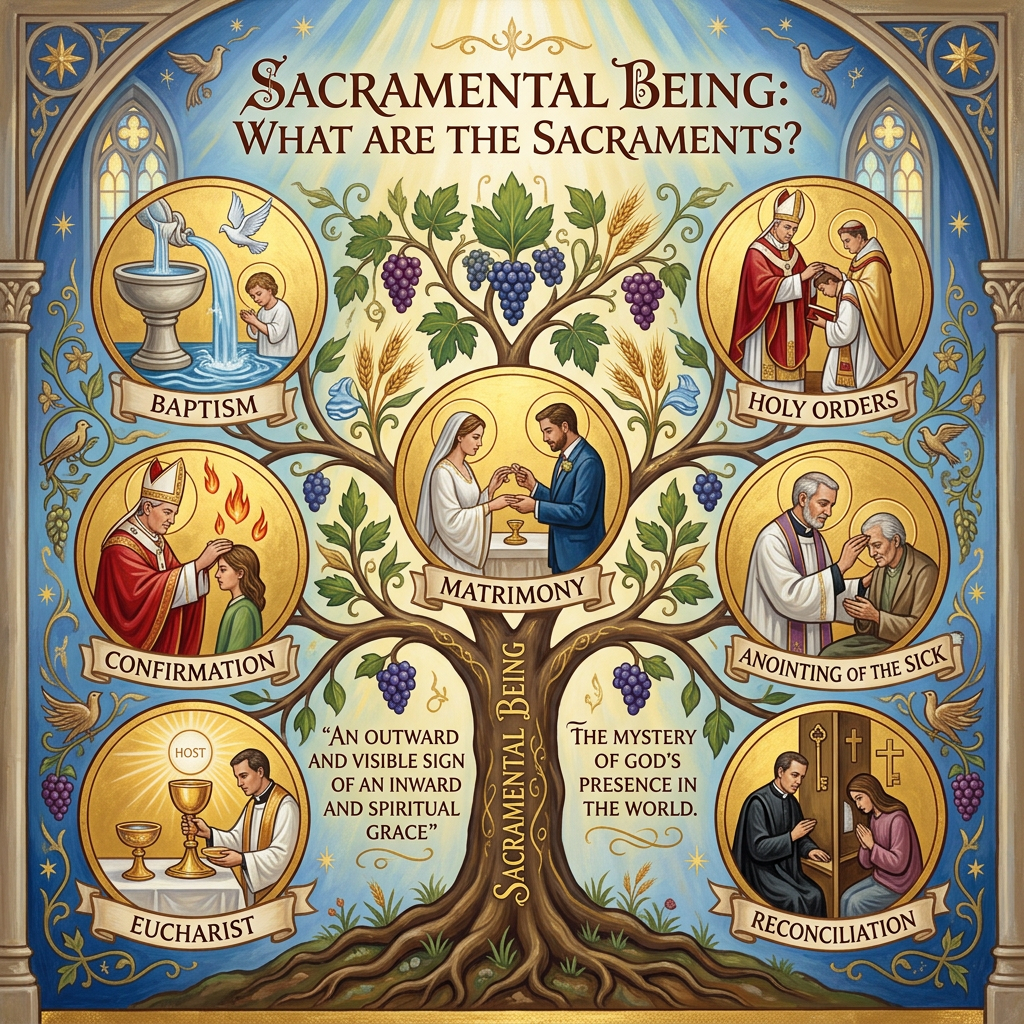
The sacraments are presented as physical actions through which believers participate in spiritual realities. The chapter discusses baptism, the Eucharist, marriage, priesthood, ordination, and sacred objects as examples of how the physical world can communicate and participate in divine life. The central message is that Christianity is not merely something to believe intellectually. It is a life with Christ in which the whole person, body and soul, participates.
Most Important Ideas I came away with?
1. The Sacraments Reconnect Us With the Life of Christ
The chapter continues the earlier analogy of God as the Arche, the ultimate source of life and being. Humanity’s separation from God through the Fall resulted in death and corruption. Christ, however, reconnects humanity to its divine source.
The sacraments are therefore not merely symbolic religious ceremonies. They are presented as ways in which human beings participate in the life of Christ.
2. Baptism Is Entry Into a New Life
Baptism represents a person’s entrance into the sacramental life of the Church. The chapter describes our old humanity as connected to Adam and therefore affected by mortality.
Through baptism, the believer is connected to Christ as the new source of life. The chapter’s electricity analogy describes baptism as being “plugged in” to Christ.
This also emphasizes that salvation concerns the whole human person. Christianity does not seek simply to save an invisible soul while disregarding the body. The person, body and soul together, is renewed in Christ.
3. The Eucharist Is at the Heart of Sacramental Life
If baptism connects us to Christ, the chapter describes the Eucharist, or Holy Communion, as the continuing nourishment of that relationship.
The Incarnation is crucial to this understanding. God the Son became physically human in Jesus Christ. Therefore, the spiritual and physical come together in Christ Himself.
The chapter presents Communion not merely as remembering Jesus but as actually participating in His life. In the author’s electrical analogy, baptism plugs us into Christ, while the Eucharist provides the “electricity” or divine life that flows from Him.
4. Marriage Is a Sacramental Union Rather Than Merely a Contract
The chapter contrasts a secular, contractual understanding of marriage with a sacramental understanding.
A contract primarily joins two individuals through agreed obligations. Sacramental marriage, however, represents a deeper union in which two people share a common life.
The chapter uses the image of a lock and key, two distinct parts forming one mechanism. Marriage therefore becomes a place of spiritual transformation in which spouses learn to suffer together, rejoice together, care for one another, and move beyond an exclusively individual understanding of life.
5. Priesthood and Sacred Objects Reflect Sacramental Reality
The chapter describes the priesthood as essential to the Church’s sacramental life. Through ordination, authority and responsibility are handed down through generations of the Church, much as something precious is transmitted through a family.
The chapter also explains why sacramental Christianity treats certain physical objects with particular reverence. If physical and spiritual reality are interconnected, physical things may participate in spiritual realities.
This helps explain why sacramental Christianity places importance upon physical actions, sacred places, sacred objects, water, bread, wine, oil, and other material elements within worship.
What Question Do I Still Have?
If the sacraments truly unite physical and spiritual reality and allow us to participate in the life of Christ, how should receiving the sacraments transform the way I live, treat other people, and experience ordinary life outside the church?
For me, this question moves the discussion from understanding the sacraments intellectually toward actually living sacramentally.
Personal Reflection
This chapter I read helped me see why the physical dimension of Christianity is so important. Faith is not simply something that occurs within the mind or even within the soul. We are physical and spiritual beings, and therefore our relationship with Christ involves the whole person.
I particularly appreciated the progression from baptism to Eucharist. Baptism represents entering into the life of Christ, while Communion represents continuing to receive and participate in that life. Through these sacraments, Christianity becomes more than believing certain truths about Jesus. It becomes participation in Him.
The discussion of marriage also challenged me. If marriage is sacramental rather than merely contractual, then marriage cannot be understood principally by asking, “What am I receiving from this relationship?” Rather, it calls two people toward a shared life of sacrifice, growth, faithfulness, and love.
Perhaps the deepest lesson for me is that sacramental Christianity brings together what modern thinking often separates: body and soul, visible and invisible, physical and spiritual, belief and participation.
This challenges me to move beyond simply studying Christianity toward experiencing and living my faith. The sacraments remind me that following Christ is not merely about understanding Him. It is about participating in His life and allowing His life to transform mine.


Leave a Reply